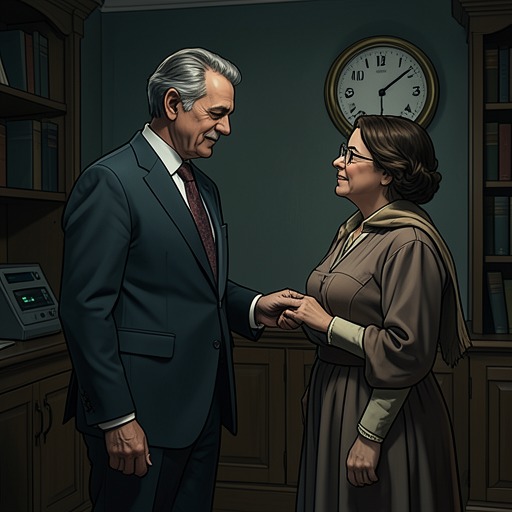
Ausencia Santander
Love in the Time of CholeraAusencia Santander is a woman of nearly fifty whose confident, self-directed desire unsettles Florentino Ariza’s ideas about love. A grandmother after a conventional twenty-year marriage, she becomes his lover for more than seven years, teaching him through experience that life cannot be mastered by theories. Her affair plays out in a sea-facing house filled with objects brought home by Captain Rosendo de la Rosa; one afternoon, while she and Florentino sleep, the house is emptied by thieves, leaving their intimacy and the consequences of her concealed relationship starkly exposed.
Identity and Background
Ausencia had been married for twenty years and had three children, all of whom had married and had children of their own. She boasted of being the grandmother with the best bed in the city. The account leaves the status of her marriage unresolved: it was never clear whether she had left her husband, he had left her, or they had abandoned one another together. He went to live with his regular mistress, and Ausencia thereafter felt free to receive Captain Rosendo de la Rosa openly at the front door, though she had previously met him at the back door in the middle of the night.
Her home was as distinctive as its owner. Bright and cool, it had four large windows facing the sea and looking toward the old city. Its crowded furnishings included handcrafted objects Rosendo had collected on his voyages, and a beautiful white cockatoo from Malaya sat on the sea terrace. The house’s fullness and welcoming sensuality would later make its sudden emptiness especially consequential.
The Affair and Florentino’s Education
Rosendo introduced Ausencia to Florentino Ariza over lunch, bringing homemade aguardiente and the ingredients for an elaborate sancocho. Florentino was struck less by the meal or Ausencia’s exuberance than by the beauty of her house. Before they could sit down to eat, Rosendo drank half the demijohn, collapsed, and had to be dragged to bed by Ausencia and Florentino. In the next room, the two undressed without discussing or proposing it. That unplanned beginning became an affair lasting more than seven years, conducted whenever Rosendo was away on a trip.
Rosendo’s habit of announcing his arrival by sounding the ship’s horn helped define the lovers’ opportunities. He gave three long blasts for his wife and nine children, followed by two short, melancholy blasts for Ausencia. Florentino learned to read the ship’s itineraries and visit her at any hour, always without warning. She would open the door naked, with an organdy ribbon in her hair, and would not let him proceed until she had undressed him, believing it unlucky to have a clothed man in the house. Her ritual was precise and decisive: she removed his clothes, while he made a point of putting his watch and chain and his glasses inside his boots so he would not forget them.
Their sex did not follow Florentino’s preferred script. Ausencia took the lead and pursued her own pleasure with a concentration that left him exhausted and feeling like an instrument rather than a partner. He protested that she treated him as if he were just anybody; she laughed and answered that she treated him as if he were nobody. He would leave determined not to return, yet wake in the night remembering the happiness he both despised and desired. Ausencia’s experience undid the simplistic theories he had formed about women’s appearance and aptitude for love. His notes for a practical supplement to the Lovers’ Companion came to nothing; what he learned instead was that nobody teaches life anything.
Intimacy and the House’s Ruin
For a long time Florentino kept the affair tightly bounded. Although he felt at home in Ausencia’s house, he never stayed longer than two hours, never slept there, and ate there only once by formal invitation. He came for the affair, usually bringing a single rose, and then disappeared until his next visit. Two years after their first encounter, a small change in Ausencia’s routine revealed a change in feeling: instead of beginning to undress him, she first removed his glasses so she could kiss him more easily. They made love gently, fell asleep, and spent the afternoon naked in Rosendo’s enormous bed.
When Florentino awoke, the cockatoo was crying out, and the four-o’clock heat lay over the quiet room. He said he felt strange, as if someone were watching them; Ausencia laughed at his explanation. They remained together in silence without making love again. At five, she got out of bed to find a drink and screamed upon leaving the bedroom. Everything in the house had vanished: signed furniture, Indian rugs, statues, handwoven tapestries, valuables, trinkets, and even the cockatoo. The thieves had carried it all out through the sea terrace without disturbing the sleeping lovers. Only the wall lamps remained, along with a message painted on the rear wall: This is what you get for fucking around.
Rosendo could never understand why Ausencia did not report the robbery, contact dealers in stolen goods, or allow the misfortune to be mentioned again. She and Florentino continued meeting in the looted house, where three leather stools left behind in the kitchen and the contents of the bedroom were all that remained. But Florentino visited less often—not, as Ausencia supposed, because he was repelled by the desolation, but because a mule-drawn trolley had become a new opportunity for secret encounters. The disappearance of her possessions thus alters the setting of their affair, while the lovers’ silence about the robbery leaves its personal meaning unresolved.
Character and Narrative Significance
Ausencia’s sexual autonomy is rendered through her actions and through Florentino’s inability to interpret them on his own terms. She initiates their intimacy, controls its ritual, and takes pleasure without organizing it around his pride. His sense of being reduced to an instrument coexists with his longing to return; the contradiction exposes the limits of the theories with which he had tried to systematize desire.
The robbery brings that private arrangement into sharp contrast with the material world surrounding it. While Ausencia and Florentino sleep, the house that had embodied Rosendo’s travels and her shared domestic life is emptied, yet their affair continues among its few remaining objects. Her refusal to report the loss is presented as a fact rather than explained by a stated motive. Ausencia remains a vivid figure in Florentino’s education: not a lesson that can be turned into a rule, but an encounter that defeats rules and leaves him with a more difficult knowledge of love.